
Chalkline Solar, original concept, not client work
A website concept for a solar installer
The visitor decision it answersDo I understand what my roof needs before I ask for a quote?
The first screen shows a roof being surveyed, with chalk lines and a tape measure, and says a named surveyor visits first. It offers one yellow button: Request a quote. The rest of the page, shown below, answers what a homeowner or small-business owner would worry about next.
 1
The whole page at a glance
The desktop design has eight parts. Part 1 is the first screen above. Scroll inside the frame for parts 2 to 8; the list says what each part does for someone who has never had solar fitted.
 2
 3
 4
 5
 6
 7
 8
- 1. First screen (shown above). Says the survey comes first and offers one action: request a quote.
- 2. Four parts, one roof. Names panels, rails and hooks, inverter and consumer unit on a real roof, with one plain line each.
- 3. The survey, step by step. Four steps from looking at the roof to a written quote, and the promise that nothing is fixed until the plan is read.
- 4. Then we look indoors. The loft, the fuse board and the cable route, so the visitor knows what the visit covers.
- 5. Whatever your roof is made of. Tile, flat and small-business roofs, each with a line on how it is checked.
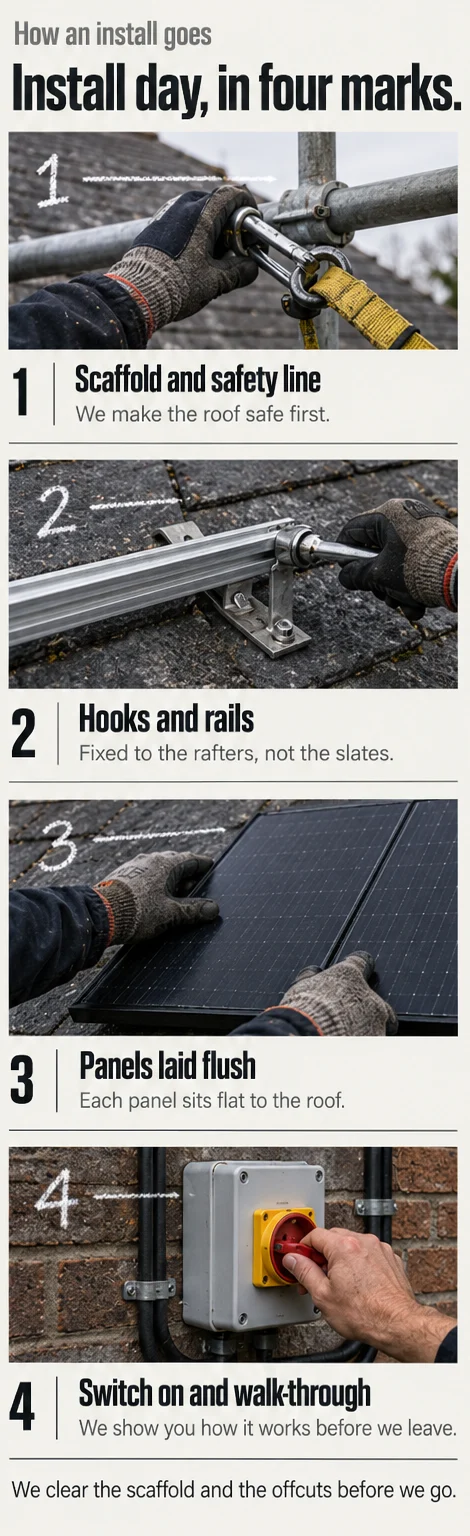
- 6. Install day, in four marks. Scaffold, hooks and rails, panels laid flush, switch on and walk-through.
- 7. Questions before you ask. Six questions, from roof damage to what the visitor gets at the end.
- 8. Ask for a quote. A short job-sheet form, three reassurance lines, the address and hours, where the page ends.
On a phone
Four real phone windows from the mobile design, each cut from our design boards at its own size. The desktop page is not squeezed in.

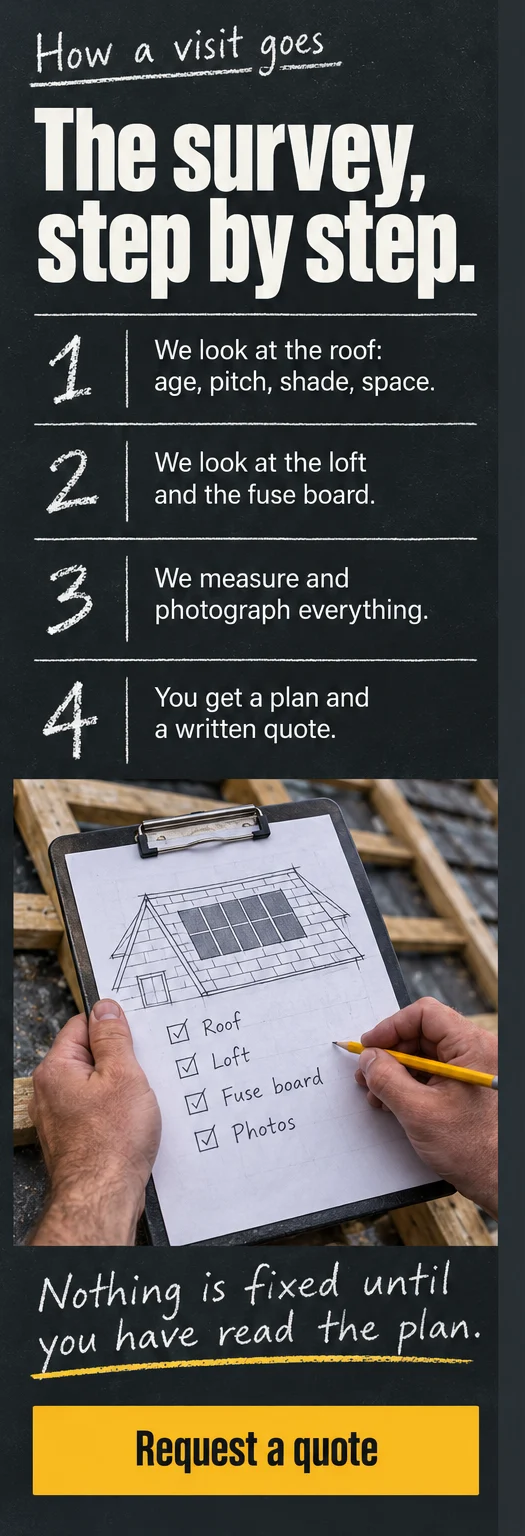
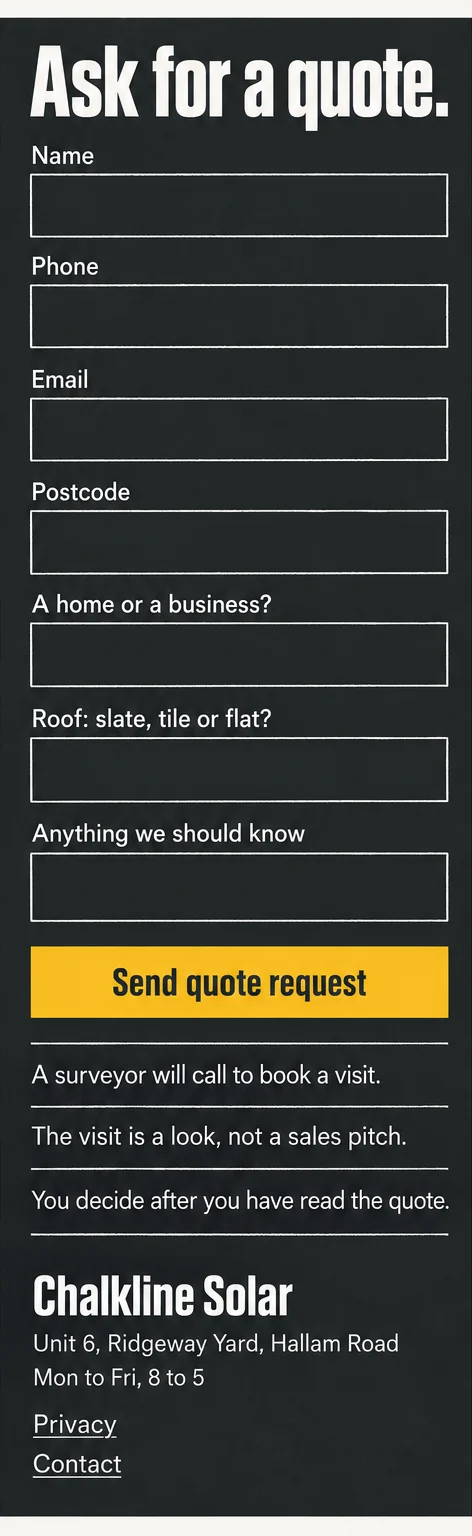
- Buttons run the full width. The yellow Request a quote button in windows 1 and 2 is about 72 px tall at phone width, and Send quote request in window 4 about 58 px (measured on the images).
- One column, nothing side by side. The four install photographs stack, each with its number and line beneath, so no line needs a pinch to read.
- The form is stacked. Seven labelled fields, then one button (window 4).
Why it is built this way
Four worries a homeowner or small-business owner has before asking an installer for a quote, and the part of the page that answers each.
The visitor worriesWill they push me into buying?
The design answers, parts 1, 3 and 8The first screen says you see the plan before anything is fixed, the survey says nothing is fixed until you have read it, and the form says the visit is a look, not a sales pitch.
The visitor worriesWhat would actually go on my roof?
The design answers, part 2Four parts are named with chalk labels on a real roof: panels, rails and roof hooks, inverter, consumer unit. Each gets one plain line.
The visitor worriesWhat happens, and who turns up?
The design answers, parts 3, 4 and 6The survey, the loft and fuse board check, and install day are each shown in numbered steps. The page promises a named surveyor and a walk-through before the team leaves.
The visitor worriesIs my roof, or my business, covered?
The design answers, parts 5 and 7Tile, flat and small-business roofs are shown with how each is checked, and the questions answer what happens if the roof is flat or tiled, and whether the firm works on businesses.
What this would do for your business
A page like this has one job: turn people who are curious into people who ask for a survey. This concept has never run for a real installer, so we have no results to show and will not invent any.
What we can promise is that you would be able to see what it is doing. We would set up the measuring when the site goes live, so after a few weeks you can tell what works and what to change. We do not promise a number of quote requests: that depends on your firm, your area and your prices.
What we would measure
- Quote requests. How many people send the form, and whether the roof is a home or a business.
- Calls. Taps on the phone number, and where they came from.
- Form completions. How many start the form, and how many finish it.
What we need from you
- Photos. Your own installs and the roof types you work on.
- Your survey and install steps. What happens, in what order, and who comes.
- Your roof types and limits. What you take on, and what you do not.
- Your approvals and warranty wording. Whatever you are certified for, in your own words.
- Hours, address and service area.
- Who answers quote requests. A name or inbox, so no one waits.
You answer these questions and review the plan and design before anything goes live. Two design revision rounds are included.
Want homeowners to feel ready to ask for a quote?
Tell us about your project and we reply with next steps. No cost, no obligation.
Matching service: Custom websitesRead next: Request-a-quote forms that get answered